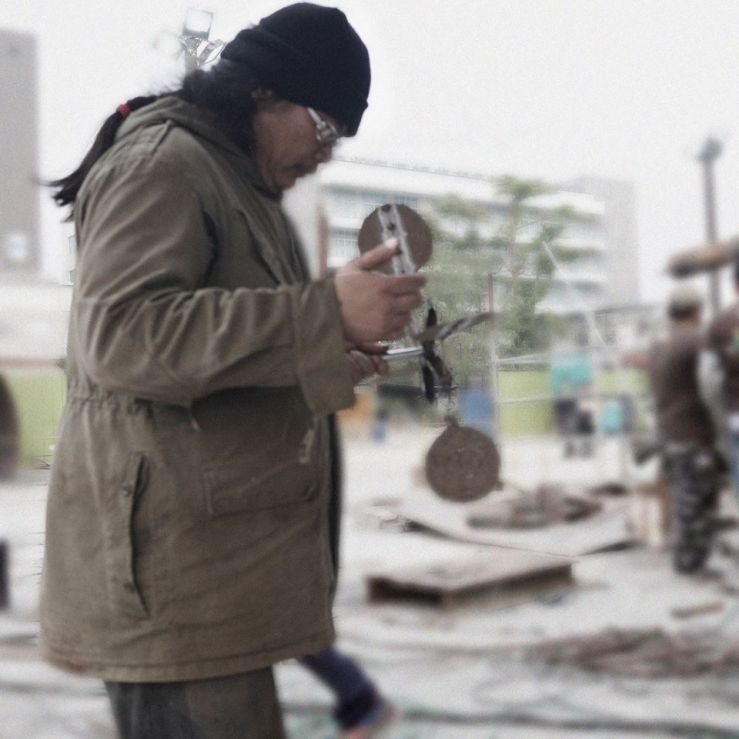
1979年生於台灣台北
林育正(Lin Yu-Cheng)於1999年首次個展於國立台灣藝術大學雕塑學系實驗藝廊(National Taiwan University of Art),並於2002年畢業於國立台灣藝術大學雕塑學系(Entitled as “Bachelor of Fine Art,” Department of Sculpture, National Taiwan University of Art),創作路線除專注於動力雕塑(Kinetic Art)領域的探究之外,並參與劇場舞台跨領域合作及公共藝術實務運作。
創作主軸為思索自身窩居於城市之中的空間身分論述,藉由物件進入空間去提引習以為常而忘卻之建築角落,仰或是自身對於建築物及城市訊息的吸收轉化成概念後組裝成作品裝置。
2010年前創作路線以製造目的未明的無用金屬機械,以進入建築空間中去進行類考古形式的挖掘為主要創作形式,藉由此類考古挖掘的方式試圖去凸顯建築物垂直水平的物理狀態以及提示我們已習以為常的建築角落(如地面、牆角、天花板等)的存在。
2010年開始創作路線修改為箱構(BOX-OLOGY)及恍惚流轉的小城雜碎(Wandering Fragments of CITY)兩大軸線,藉由翻模再製建築物水泥、磚塊等建築殘骸,並於其中組裝入”自製”的水泥齒輪、自製水泥機械結構(mechanism)、現成物翻製水泥物件等,試圖去假造一個恍若年代久遠的文明化石早已存在於建築物體之中默默運作低語呢喃的弔詭氛圍,藉由機械運轉反覆之特性象徵藝術家所感知到都會生活中之重複無奈的循環狀態。
Lin Yu-Cheng was born in Taiwan in 1979 . His first solo exhibition took place at Experimental Gallery of Department of Sculpture, National Taiwan University of Art. He graduated from the Department of Sculpture, National Taiwan University of Art in 2002. Aside from focusing on Kinetic Art , Lin Yu-Cheng was engaged in cross-discipline cooperation stage design and practical public art.
He reflected on one’s identity in city. Entering a space by objects, he reminded audience of those corners of buildings which have been taken for granted. He turned his perceptions of building and city into art installation.
Before 2010, he took useless metal to enter a part of a building and conduct archaeological-like excavation. By doing so, he emphasized the horizontal and vertical status of the building to remind audience of the existence of some parts of a building, which people have taken them for granted, like floor, corners and ceiling.
Started from 2010, he turned to BOX-OLOGY and Wandering Fragments of CITY. By re-molding concrete, bricks and relics, adding self-made concrete gears, mechanism and other objects, he tried to create, under queer atmosphere, a civilization that had been in the building long time ago which murmured and operated quietly. Gears Operating repeatedly symbolized what the artist perceived about city life: helpless circulation.
 YU CHENG LIN